You'll discover :
- The Real Risks of Generative AI to the Quality of Your Brand Content and Your Customers’ Trust.
- The limitations of the traditional brand book in light of the need for agility among your local teams and partners.
- How to quickly deploy brand-compliant content using smart templates and protect your brand ecosystem.
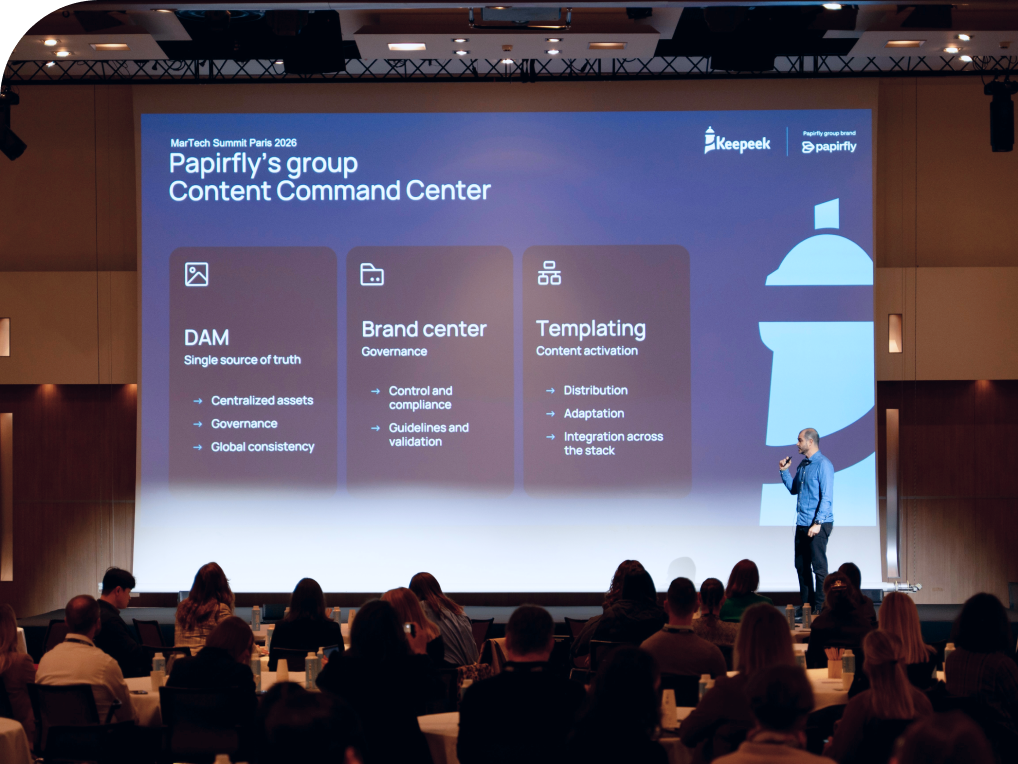
Generative artificial intelligence is transforming graphic and textual creation. While it speeds up production, it also threatens the consistency of companies’ brand identities. How can marketing teams stay in control? In this article, we reveal practical solutions—presented at our conference at the MarTech Summit Paris 2026—to manage your media. Discover the essential methods for scaling your local campaigns while protecting the integrity of your unique visual identity across all your channels.
The Impact of Generative AI on Your Brand Content
The production of marketing content is accelerating at an unprecedented pace. Companies are facing increasingly complex and decentralized organizations. Marketing executives define global strategies from headquarters. They must then adapt these campaigns to the specific characteristics of each local market. This adaptation takes into account regulatory constraints specific to each country. It also requires the translation and adaptation of messages into multiple languages.
The number of on-the-ground players is growing, and local teams, partners, agencies, and franchises are voicing immediate needs. They must act quickly to capture the attention of their target audience. The recent emergence of generative artificial intelligence has radically simplified the creative process. Tools like ChatGPT make it possible to create text and graphic messages in the blink of an eye. However, this ease of access poses a hidden threat to companies’ reputations.
AI empowers users to create instantly; any user can generate a document or visual without technical skills. This phenomenon poses an immediate risk to the consistency of your brand content. Automated outputs often mimic a company’s visual identity without adhering to its standards. Graphic nuances are lost. For example, AI-generated posts may resemble official campaigns but lack true consistency. Consumers can spot these differences in quality.
Another major issue lies in the standardization of messages. Generative AI applies repetitive structures. We conducted a creative test for a spring campaign for several well-known brands, and the algorithm consistently reproduced the same pattern: the product is displayed on the right, the text is placed on the left, and the whole thing is framed by a pink floral background. This standardization undermines the company’s image. The messages become generic and blend in with the competition.
The massive volume of documents created locally is beyond the control of headquarters. Teams find themselves overwhelmed by the sheer number of files. These unmanaged resources become difficult to catalog, retrieve, and utilize. To organize these complex workflows,the automation of content creation has emerged as an essential technical solution for modern businesses.
The Risks of Uncontrolled Content Production for Your Brand Ecosystem
The proliferation of generic visuals directly erodes consumer trust. Statistical analyses published by consulting firms such as Gartner, Forrester, and McKinsey confirm this trend. The data shows that 43% of consumers refuse to buy from brands that use AI-generated content. Overreliance on algorithms turns the public off. Furthermore, 80% of consumers say that overuse of AI would prompt them to switch brands. Customer loyalty plummets when communication loses its human authenticity.
The study also indicates that 55% of respondents have a negative opinion of AI-generated communications. These indicators show that your most valuable asset is under direct threat. AI speeds up production, but it can damage a company’s reputation in an instant. Your brand ecosystem suffers significant losses if communications are not properly managed. Centralized control over content becomes the only safeguard for preserving the company’s value.
Centralize and Guide: Beyond a Simple Brand Book
Protecting a brand’s identity requires centralizing digital resources. A Content Command Center allows you to consolidate all multimedia files. This centralization takes place within a Digital Asset Management (DAM) tool. The platform brings together all content approved by the company. It precisely manages usage rights and licensing permissions. Approval workflows ensure that every available resource complies with brand standards. The Brand Center enables the centralization and distribution of brand guidelines to users.
However, simply storing files is not enough to ensure consistency across a network of distributors. Marketing departments must explain the visual identity guidelines to their teams and franchisees. Traditionally, companies provide a Brand Book. This document—whether in print or digital format—compiles the guidelines that must be followed. However, theoretical guidelines are often insufficient in practice. Local partners interpret the guidelines subjectively. Even a comprehensive and detailed Brand Book does not always prevent errors in implementation.
This situation can be compared to a recipe. Having a list of ingredients and steps does not guarantee the quality of the final dish. The result depends on how it is prepared. Your brand content therefore requires more rigorous tools than simple written guidelines. To effectively oversee these practices, using an effective brand management tool helps structure day-to-day operational procedures.
Smart templating to generate brand-compliant content
Technology provides a concrete solution through smart templates. These smart templates serve as a protective barrier for the brand identity. The digital template is configured and pre-approved by the design department at headquarters. Graphic designers lock down the essential structural elements. The logo, official typeface, brand color palette, and layout cannot be modified. Users in the field can only edit the editable fields. They can enter local text, translate a message, or update a price in just a few seconds.
This approach resolves the long-standing bottleneck issue. Under the old model, subsidiaries had to seek approval from headquarters for every minor change. This process lacked agility and slowed down business operations. Fast-food franchisees and car dealerships need to roll out local promotions immediately. They cannot wait for the central team to approve them.
Smart templates give the distribution network true autonomy. Employees can roll out campaigns quickly without compromising the company’s visual identity. Global marketing defines the strategy, regional subsidiaries adapt the message, and retail locations implement it. The network thus produces brand-compliant content independently and securely.
Replay: Boost Your Marketing Content in the Age of AI
Find out how to stay in control of your brand.
BMW's Approach to Managing Its Brand Ecosystem
The automotive sector attests to the operational success of this modern organizational structure. Major automakers manage complex international networks. The BMW Group applies this strategy to harmonize its communications on an international scale. The brand coordinates its activities across seven different countries. It collaborates on a daily basis with numerous communications agencies, independent dealerships, and internal teams.
The implementation of a single content-sharing system centralizes all digital content. Local dealerships log in to the DAM to retrieve official files. They use pre-designed templates to create their local promotional materials. Every display, every digital publication, and every brochure strictly adheres to the manufacturer’s brand image.
This approach protectsthe overallbrand ecosystem from local deviations in graphic design. The network gains speed in execution while remaining faithful to the parent company’s professional quality standards. The autonomy granted enhances the impact of local marketing initiatives without ever compromising the brand’s overall reputation.
The Benefits of Strategically Distributing Your Brand Content
The smart activation of digital resources delivers tangible performance gains for marketing departments:
- Shorter time-to-market: Retailers can launch campaigns instantly. For example, our client La Redoute reduced its time-to-market from 72 hours to 24 hours using the Keepeek DAM.
- Significant budget savings: Reusing existing files eliminates the need to pay for constantly recreating visuals. Production budgets are optimized. Our client Intermarché saved 1 million euros by eliminating the need for rework thanks to Keepeek.
- Reduced quality control time: Marketing managers no longer spend their time manually checking every document. Smart templates eliminate the need for systematic proofreading. Our client, Auchan, has reduced by two-thirds the number of employees whose job was to review the media produced.
- Increase in the volume of local campaigns: Subsidiaries and franchises are running more targeted offers without overburdening the creative teams at headquarters.
- Increased visibility in AI search engines: Consumers are increasingly using language models to find products. The seamless integration of textual and visual data improves a company’s organic search rankings and its positioning in the responses provided by large language models (LLMs).
Generating massive volumes of messages is no longer a differentiating factor in 2026. Widespread access to artificial intelligence allows any player to saturate the advertising space. Commercial success now belongs to organizations capable of effectively managing and leveraging their resources. Protecting a company’s reputation requires the consistent distribution of brand-aligned content across all customer touchpoints.
FAQs
Why does generative AI pose a risk to brands?
Although AI significantly speeds up production, it often generates standardized visuals. When used without oversight by local teams, it leads to the creation of generic materials, thereby diluting the identity and strength of your brand ecosystem.
Is a Brand Book Enough to Guide Creative Work at the Local Level?
No, a brand book—even a detailed one—always leaves room for human interpretation. Just as a recipe doesn’t guarantee that a dish will turn out well, simple written guidelines aren’t enough to prevent graphic design errors in practice.
What is a smart template, and what is it used for?
This is a document template that has been pre-approved by headquarters. The core elements (logo, colors, typography) are locked. Local employees can only modify authorized text or images. This ensures that brand-compliant content can be produced with just a few clicks.
How can you avoid a "bottleneck" at the marketing headquarters?
Headquarters must shift from a model of individual content approval to one of supervised autonomy. By centralizing digital resources in a DAM and providing smart templates, headquarters enables dealerships, franchises, partners, and local teams to roll out their campaigns without waiting for systematic approval.
What are the benefits of a Content Command Center?
Centralizing your creative processes helps reduce production costs, speed up the rollout of campaigns across different markets, and ensure that your brand content always has the proper usage rights for seamless multichannel consistency.