What you'll learn:
- Why the Speed of "AI " Shouldn't Harm the Brand
- Why trust in a brand and its reputation now directly influence business performance
- Why marketing directors are moving away from traditional campaign playbooks in favor of systems that ensure brand consistency at scale
Marketing execution has never been easier, yet building a brand that people truly trust has never been harder.
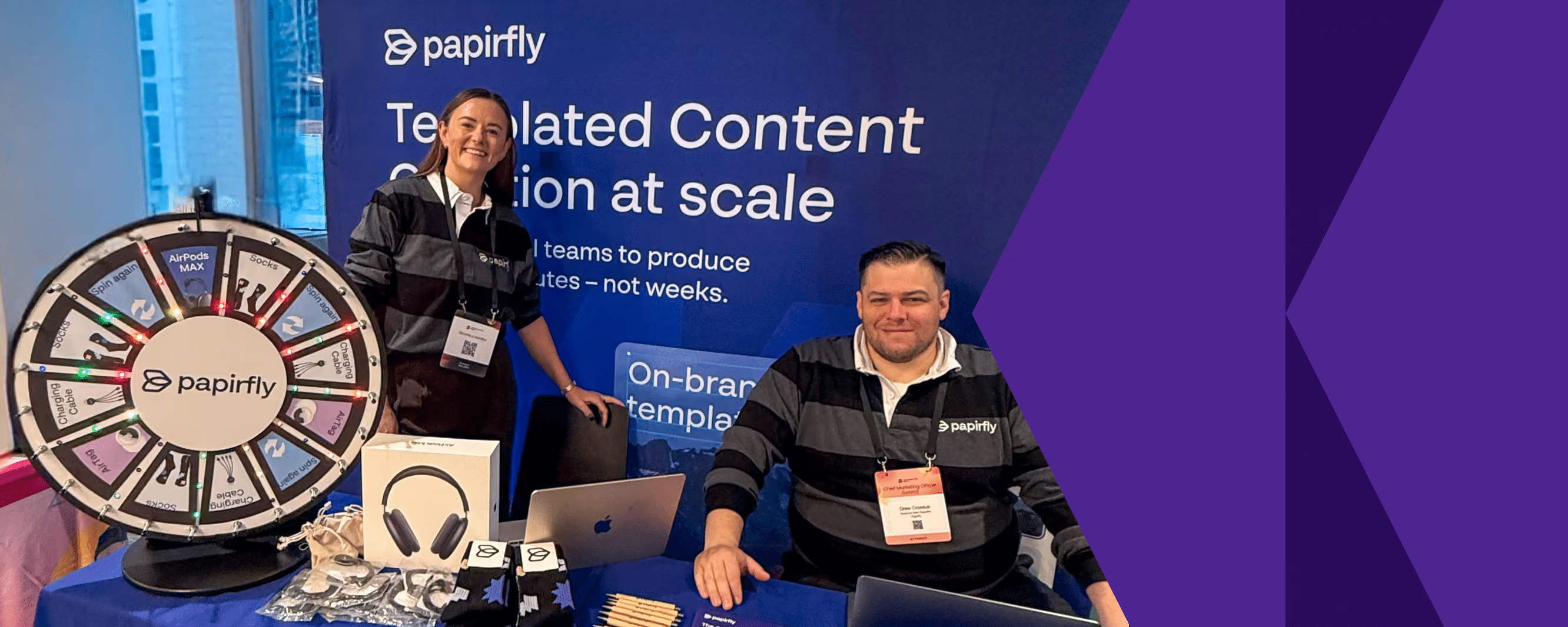
At the CMO Alliance in New York, an event in which the Papirfly Group recently participated, marketing executives from major international corporations gathered to discuss the evolving role of the CMO. Throughout the sessions and discussions, one conclusion became clear: speed of execution is no longer a significant advantage.
What matters now—and what sets the most successful brands apart from the rest—is the strength of their systems and the brand reputation that underpins them.
Why does the acceleration of marketing execution create a new challenge?
GenerativeAI s have profoundly transformed the pace of marketing. Campaigns, email infrastructure, and advertising copy—tasks that once required weeks of coordination can now be completed in just a few hours.
For many teams, this looks like progress. But it raises a challenge that not all organizations have yet fully embraced.
When all teams use the same tools, the results eventually start to look alike. The more companies rely on similarAI platforms and prompts, the more their content converges. Speed increases—while differentiation gradually fades away.
Andrew Weiss, CMO of Ceeple, describes this phenomenon as a “marketing plateau.” The instinctive reaction is to keep doing more—more content, more campaigns, more tools—while chasing short-term metrics. But this approach rarely works.
When all players use the same tools, those tools can no longer serve as a means of achieving sustainable differentiation.
Trust: A Business Indicator in Its Own Right
If execution becomes standardized, what really sets a brand apart? The answer is clear: trust.
Khalid Latif, CMO of Consumer Reports, points out that a brand acts as a signal that helps audiences decide where to invest their time, attention, and money. In an environment saturated with information and options, trust becomes a shortcut to decision-making.
The data confirms this:
- 81% of consumers say they need to trust a brand before making a purchase (source: Edelman Trust Barometer, 2024)
- 63% of a company’s market value is tied to its reputation (source: Weber Shandwick Reputation Dividend Report)
- Companies with a strong reputation can outperform their competitors by up to two and a half times in terms of value growth (source: Reputation Institute)
- 61% of consumers are more likely to buy from brands they perceive as reliable and well-established (source: Nielsen)
Brand reputation now lies at the intersection of marketing, leadership, and business performance—and must be managed just as carefully as revenue.
Authenticity takes precedence over superficiality
Traditional marketing communication strategies are becoming less effective. Consumers are more skeptical of promotional messages and place greater value on transparency, demonstrated expertise, and real-world utility.
Consumer Reports is a good example: rather than promoting itself, the company produces content based on scientific data, explaining its methods and results. Credibility built on evidence, not rhetoric.
Conclusion: Educational content and transparent communication build trust more effectively than simply well-executed campaigns. Audiences can tell the difference.
Strong brands foster dialogue
Audiences no longer expect just messages—they expect interaction.
Formats like Reddit's AMA sessions allow experts to answer questions from the public directly, offering a level of transparency rarely seen in traditional brand communication.
Open-ended articles, well-reasoned opinions, and honest perspectives: these formats foster genuine engagement, far beyond the surface-level nature of overly polished communications.
The most engaging content doesn't always aim to provide a definitive answer. Above all, it asks a relevant question.
Playbooks are becoming obsolete; systems are creating the edge
As Andrew Weiss puts it: playbooks are becoming obsolete, and systems create a cumulative effect.
Traditional playbooks were designed for stable environments, where the advantage lay in better execution of tactics. The “AI ” changes this logic. When execution becomes easily reproducible, the advantage shifts to the systems that govern it.
Three key principles emerge:
- Think before you act—define the problem before taking action;
- Design for change, not for stability;
- Use data to formulate hypotheses rather than to validate the status quo.
The role of the CMO is evolving: the focus is now on building teams that can adapt and operate effectively, regardless of the tools they use.
The Underestimated Challenge of Brand Governance
AI accelerates content production and expands the pool of contributors. Local teams, agencies, partners, and non-marketing staff—everyone can now create branded content.
The result: content volumes are skyrocketing—more campaigns, more media, more markets—often with less centralized control.
Without robust brand systems, the consequences are predictable: inconsistent messaging, content that doesn’t adhere to brand guidelines, fragmented experiences…
The question CMOs are asking themselves today is no longer “What should our brand say?” but “How can we ensure that every team communicates it effectively?”
Successful companies invest in:
- clear governance,
- a structured brand positioning strategy,
- systems that enable distributed teams to move quickly while staying aligned.
It is in this alignment between strategy and execution that the true competitive advantage lies.
Continue the discussion
The topics discussed at the CMO Alliance event are part of a broader discussion on the evolution of brand strategies and content operations in the era ofAI.
In the recording of the webinar organized in collaboration with MarketingProfs, titled “Rethinking Your Brand Strategy: Maintaining Content Authenticity in the ‘Zero-Click’ Era,” we explore these challenges in greater detail.
This discussion brings together the perspectives of Stefan Gass, CMO of Papirfly, and Maarten Evertzen, Partner/Managing Director at VIM Group, on how international brands are rethinking the management, governance, and implementation of their brand strategy.
Ready to rethink your brand strategy?
Find out what brand experts have to say about maintaining authenticity and consistency at scale.
Watch the replay.
FAQs
What are the key takeaways from the CMO Alliance?
AI s standardizes marketing execution, making content production accessible to everyone. At the same time, brand trust is becoming a key differentiator. Teams are shifting from a campaign-based approach to a governance-based approach.
Why is trust becoming so important?
As delivery capabilities become standardized, content tends to converge. Trust—built on consistency, authenticity, and transparency—becomes a key differentiator.
Playbook vs. system: What's the difference?
A playbook is based on tactics tailored to a specific context. A system, on the other hand, is designed to be sustainable and adaptable, incorporating governance, processes, and organizational structure.
What impact does theAI have on brand governance?
AI s increases production and the number of contributors. Without a solid framework, this leads to inconsistencies and fragmentation. The faster the pace, the more critical governance becomes.
Which formats build trust?
Educational, transparent, and conversational content outperforms promotional approaches. Audiences value brands that demonstrate their expertise and foster dialogue.



.avif)