We are pleased to be participating in the All4Customer 1-to-1 Meetings in Cannes, the event that brings together experts in customer experience, AI, and digital marketing. Join us September 15–17 to discover how Keepeek can help you deploy your marketing content.
Retail content management system: La Redoute's Content Factory
This morning, Keepeek, Grand Shooting, and La Redoute shared their practical experiences (replay at the bottom of the page) during a breakfast meeting on the implementation of an effective retail content management system .
This conference provided an opportunity to review the structure of a Content Factory, the industrialization of visual content management, and the optimization of media flows for e-commerce. Cédric Leroux, head of La Redoute's Content Factory, shared his real-world experience of the challenges of governance, collaboration, and performance.
A retail content management system at the heart of e-commerce challenges
The proliferation of distribution channels and the acceleration of time-to-market require retailers to manage content rigorously. Product images, videos, marketing documents, and supplier content must be available quickly, correctly indexed, and legally secure.
It is in this context that French e-commerce giant La Redoute embarked on a major transformation of its content production chain. The objective was clear: to structure a retail content management system capable of handling large volumes while ensuring brand consistency, internal collaboration, and e-commerce performance.
The Content Factory: a structured response to historical limitations
Before the Content Factory was set up, La Redoute's teams worked using a variety of different methods. Content was circulated via hard drives, transfer platforms, or internal servers. This fragmented organization limited overall visibility, generated duplication, and increased legal risks.
As Cédric Leroux explains: " We had no visibility on what was being created. Everyone did their own thing, with no concept of a common budget or branding."
The Content Factory was designed to centralize all digital content, whether produced in-house, by service providers, or by international subsidiaries.
DAM software for e-commerce as a central foundation
The choice of DAM software for e-commerce quickly became apparent. It had to meet several challenges:
centralization of multimedia content;
automatic indexing based on product data;
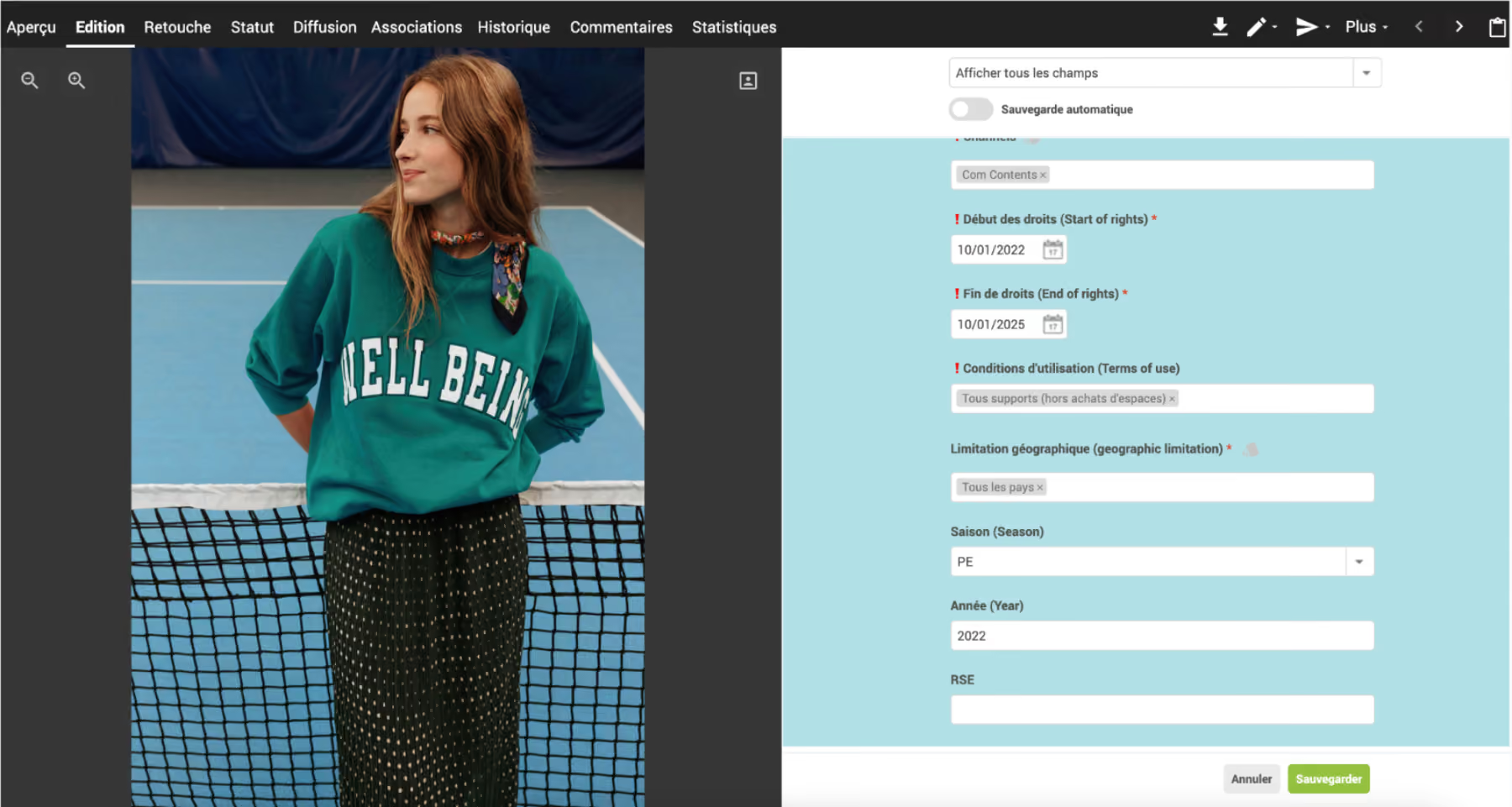
management of exploitation rights;
omnichannel distribution.
Keepeek was chosen as the central component of the system. The DAM acts as a single repository, connected to La Redoute's entire e-commerce ecosystem.
" The DAM has become our sole database. Everything that is approved is centralized there, automatically enriched, and ready to be distributed," explains Cédric Leroux.
Grand Shooting: industrializing visual production
Upstream of DAM, Grand Shooting is involved in the production and post-production of visuals. The platform makes it possible to manage photo shoots, automate certain tasks, and streamline communication between photographers, art directors, stylists, and product teams.
This organization allows for real-time validation, directly during shoots. Validated images are then automatically sent to the DAM. According to Cédric Leroux, " we've gone from 72 hours to 24 hours between shooting and publication on the site."
This time saving is a key lever for e-commerce, where speed of publication online determines commercial performance.
DAM for product information management and content governance
DAM for product information management plays a key role in organizing data. Media files are automatically enriched from the PIM: product references, colors, types, image rights, and even territories of use.
This governance reduces legal risks, an issue identified at the start of the project. " We used to publish images without knowing whether the rights were still valid. Today, every piece of media is tracked and secured," emphasizes Cédric Leroux.
Multi-channel media synchronization
Synchronization is a cornerstone of the retail content management system that has been implemented. Once content has been approved in the DAM, it is automatically distributed to:
the e-commerce site,
marketing tools,
international platforms,
retail teams.
This synchronization of multi-channel media products ensures visual consistency across all touchpoints.
Teams also benefit from advanced features such as automatic image resizing, which instantly adapts formats to the constraints of different media. This approach is part of a strategy to industrialize digital content management.
Collaboration and breaking down barriers between teams
The Content Factory is not limited to technological transformation. It is accompanied by profound organizational change. Marketing, e-commerce, and communications teams, subsidiaries, and service providers now work on a shared platform.
The DAM's collaborative tools facilitate content validation, sharing, and reuse. " We've broken out of silos. Everyone can see what's available and can use it," explains Cédric Leroux.
This approach reduces duplication and optimizes production budgets.
Automation of DAM workflows and productivity gains
Automation is a key driver of the project. Validation, indexing, and distribution workflows are orchestrated automatically.
Keepeek enablesautomate DAM workflows, from media reception to publication on e-commerce channels. This continuous flow approach improves team productivity and reduces low-value-added tasks.
The figures shared at the conference are revealing:
estimated gain of 3 hours per week per user on content search;
+ 20% productivity in post-production;
significant reduction in the number of steps in the validation processes.
A scalable system designed for the future of retail
The DAM software for e-commerce implemented at La Redoute is designed to evolve. New uses are already being explored:
integration of UGC content,
management of large creative files,
use of 3D and augmented reality,
Sharing content across the group.
" The idea is to continue automating tasks that don't add value so that teams can focus on creativity," summarizes Cédric Leroux.
DAM as the cornerstone of the retail content management system
This feedback clearly illustrates the value of a structured retail content management system. By combining industrialized production, digital resource governance, and synchronization of multi-channel media products, La Redoute has transformed its content value chain.
The Content Factory is now established as a lever for sustainable performance, serving e-commerce and all teams.
The 10 Best Brand Management Software Platforms in 2026
Brand management software centralizes media, brand governance, and template-based content creation in a secure environment. Discover 10 platforms to watch in 2026.





.avif)